A practical comparison based on 15 selection criteria, focusing on energy savings, data, and TCO impact when switching from compressed air to electric.
|
Version: 1.0 |
Date: April 15 2026 |
Executive summary
This blog helps you make an informed choice between pneumatic and electric linear actuators.
- The comparison is made based on 15 factors (see Table 1), so that not only energy but also performance and feasibility are taken into account (including design, strength, speed, accuracy, repeatability, and motion control).
- In addition to the actuator itself, system aspects play a significant role: compressed air requires additional peripheral equipment and introduces losses (compression, leakage, conditioning), while electrical solutions offer more controllability and programmability—and are better integrated into PLC/fieldbus environments for diagnostics and monitoring.
- The blog also discusses factors that influence the lifetime costs, such as maintenance, environment/temperature/noise, and expected lifespan, and delves deeper into data collection: which signals (e.g. position, current, temperature, fault codes) you can unlock, how this supports condition monitoring and predictive maintenance, and how it contributes to higher availability and more efficient energy use.
Conclusion in outline: pneumatics remains interesting for simple, fast end-to-end movements in robust environments; electric is often better when precision, flexibility, data, and energy efficiency are important. Use the 15 factors to substantiate this for each application.

Introduction
The choice between pneumatic and electric linear actuators is no longer just a matter of performance; it also determines how much energy (and therefore cost) your installation consumes. Compressed air is an expensive energy carrier and is associated with losses from compression, leakage, and conditioning. By switching to electric actuators, significant energy savings can be achieved in many applications—but only when the solution is properly sized and integrated. This document therefore outlines 15 factors that enable a well-informed decision, ranging from design, force, and accuracy to maintenance, data acquisition, and total cost of ownership (TCO).
What is an actuator?
According to Wikipedia, an actuator is a component of a machine responsible for moving and controlling a mechanism or system. A “linear actuator” is an actuator that can either push or pull with a certain force, or move a load linearly to specific positions. Although their structures may be similar, the key differences between actuators begin with their energy source, which can be hydraulic (fluid), pneumatic (air), or electric.
The right type of linear actuator is determined by how well it meets the requirements of the application, such as load, speed, accuracy, and more.
For example, pneumatic actuators can achieve very high speeds, while electric actuators offer the most precise control, as air and fluid pressure are more difficult to regulate than electricity.
In this blog post, we compare the advantages and disadvantages of pneumatic and electric actuators to help you make the right decision for your next project. Energy efficiency and lower total cost of ownership (TCO) are key factors—but they are only part of the story. Here are 15 factors to consider when choosing between pneumatic and electric actuators.
|
Factor |
Pneumatisch |
Elektrisch |
|
Design |
Simple |
Complex |
|
Force |
Depends on air pressure |
Depends on screw pitch/lead |
|
Speed |
High |
Low |
|
Accuracy |
Low |
High |
|
Repeatability |
Low |
High |
|
Motion control capability |
Low |
High |
|
Efficiency |
Low |
High |
|
Cost |
Lower initial cost |
Lower total cost of ownership |
|
Data collection |
Still developing |
Highly developed |
|
Environment |
Harsh, hazardous |
Refer to IP rating |
|
Temperature |
Higher ambient temperature |
Lower ambient temperature |
|
Noise |
High |
Low |
|
Maintenance |
High |
Minimal |
|
Life |
Estimated |
Calculated |
|
Ideal application |
End-to-end positioning |
Multi-point positioning |
Table 1. Comparison of pneumatic vs. electric actuators (overview of 15 factors)
Design
Pneumatic actuators have a simpler design, while electric actuators use more complex components, such as a screw drive (spindle) and an electric motor.
The simple design of a pneumatic actuator is also more compact than that of an electric actuator. However, when including all additional components required to generate compressed air, the overall system can ultimately take up more space. More on this later.
Here we compare a typical pneumatic actuator with an electric cylinder using a ball screw mechanism.
|
Pneumatic actuator |
Electric actuator with ball screw |
|
|
|
|
Source: https://www.orientalmotor.eu/eu/products/electric-actuators/eac |


A pneumatic actuator is also easier and faster to install thanks to its simple design. However, its motion profile is more difficult to adjust once the actuator has been selected.
An electric actuator also requires proper sizing and more complex programming to set the parameters in advance, but the motion profile can be modified relatively easily as long as the required torque, speed, or inertia does not increase.
|
TIP: How do they work? |
|
Pneumatic actuators consist of a simple design with a piston inside a hollow cylinder. The position is controlled by regulating the air supply to valves, which causes the piston to move against the force of a spring. Without air pressure, the spring force returns the piston to its initial position. Electric actuators convert the rotational force of an electric motor into a linear force using a specific mechanism, such as a ball screw. By rotating the screw, the ball nut moves forward or backward. The position of an electric actuator is determined by the number of motor rotations or by controlling the motor current. |
Although the basic design of pneumatic actuators is similar, electric actuators can be driven by various mechanisms, including a ball screw, trapezoidal screw, rack and pinion, belt and pulley, and more. The mechanism used affects the final specifications—such as load, speed, and accuracy—so that the actuator can better match the requirements of a specific application.
Below are some examples of different types of electric actuators.
|
Electric slide actuator |
Rack and pinion |
Hollow shaft rotor |
|
|
|
|


There are also different designs of pneumatic actuators, as the number of pistons in the cylinder can vary. More pistons mean more force, but it also requires more compressed air.
Force and speed
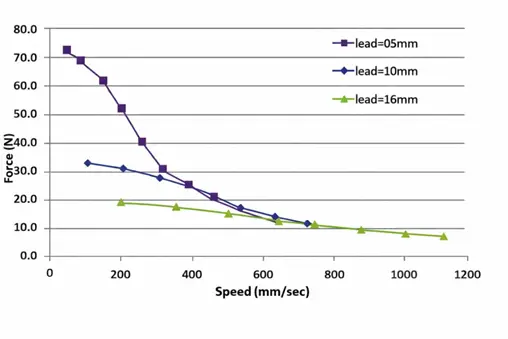
Traditionally, pneumatic actuators deliver higher speeds and lower forces compared to electric actuators. However, certain factors—such as the pitch (lead) of the screw in an electric actuator or the number of pistons in a pneumatic actuator—can influence this comparison.
In a pneumatic actuator, the force is calculated by multiplying the piston area (force factor) by the air pressure in the cylinder. In an electric actuator, the linear force is derived from the motor’s torque.
It is difficult to maintain a constant speed or force when working with compressed air. Since voltage and current are easier to control, electric actuators can maintain force and speed much more consistently, even without closed-loop feedback.
For electric actuators, a gearbox with a specific reduction ratio can also be used, allowing force to be increased at the expense of speed.
There are many options for electric actuators, so make sure you select the right one. For example, replacing a ball screw with another type that has a larger pitch/lead will change the final specifications, as shown in the graph below.
Source: https://www.medicaldesignbriefs.com/component/content/article/mdb/features/articles/26236
Pneumatic actuators typically operate between 5 and 8 bar, while electric actuators convert motor torque and rotational speed (RPM) into linear force and linear speed.
To increase the force or speed of a pneumatic actuator, more pistons and/or higher air pressure (bar) are required.
To increase the force, speed, or acceleration of an electric actuator, more torque from a larger or longer motor is required. This results in higher energy consumption, but with a well-designed system it is possible to select the highest possible efficiency that still meets the application requirements.
Accuracy & repeatability
Electric actuators excel in accuracy and repeatability, making them ideal for applications with multiple positioning points.

Source: https://www.linearmotiontips.com/does-my-system-need-high-accuracy-or-repeatability-or-both/
Since voltage and current are easier to control than air pressure, electric actuators can precisely control their position and repeat that position with the same motion profile. Pneumatic actuators are typically chosen for simple end-to-end positioning, as they simply cannot achieve the same level of accuracy and repeatability as electric actuators.
Electric actuators use servo or stepper motors, which inherently provide high stopping accuracy and good torque control. The holding torque of these motors also prevents the position from drifting.
Pneumatic actuators are gradually becoming more advanced by applying control techniques similar to those used in electric actuators. However, additional sensors and more programming are required to approach the “out-of-the-box” accuracy and repeatability of electric actuators.
Motion control capabilities
With more precise control of torque, speed, and acceleration/deceleration, electric actuators can do much more with motion profiles than pneumatic actuators.
To illustrate, the following motion profile shows what an electric actuator or motor can perform.

Source: https://www.digikey.com/en/blog/motion-control-profiles-good-better-and-best
It will be difficult to replicate this exact motion profile with a pneumatic actuator.
Electric actuators are best suited for repeating specific motion profiles thanks to their precision and accuracy. Pneumatic actuators are limited in generating motion profiles, and once implemented, these profiles are more difficult to modify.
Due to their high repeatability, electric actuators are often selected for applications with multiple positioning points and situations where multiple axes need to be synchronized.
For electric actuators, hundreds of target positions can be stored and retained for multi-point operation. Vibrations and shock loads can be minimized using custom motion profiles, such as S-curves, while pneumatic actuators rely on a hard stop and a spring.

Source: https://www.linearmotiontips.com/how-to-reduce-jerk-in-linear-motion-systems/
Absolute position control has been under development in electric actuators for quite some time. For example, multi-turn absolute encoders help reduce the required space, as external homing and limit switches are no longer needed. The latest generation of actuators uses mechanical absolute encoders, eliminating the need for a backup battery.
Energy efficiency & total cost of ownership
Another major advantage of electric actuators is efficiency.
Pneumatic actuators operate with an efficiency of approximately 10–25%, which is even lower than hydraulic linear actuators, which have an efficiency of around 40%.
Electric actuators, on the other hand, operate with an efficiency of approximately 80%.
Below is a comparison of the energy costs of a pneumatic actuator versus an electric actuator in the same application, based on a theoretical cost of $0.08/kWh.


|
“Compressed air is one of the most expensive energy sources in a factory. The overall efficiency of a typical compressed air system can be as low as 10 to 15%.” |
If only the initial purchase cost is taken into account, pneumatic actuators are the best choice. In comparison, electric actuators have higher initial costs but lower operating costs and lower maintenance costs.
However, when looking at total cost of ownership (TCO), electric actuators come out as the clear winner. This is because compressed air requires more energy to generate and is also less efficient than electrical energy when converted into linear force.

Short-term costs consist of purchase and installation costs, while TCO includes replacement costs, installation of air lines, and maintenance. It is also important to remember that air compressors require electricity to operate.
|
TIP: What is Total Cost of Ownership? |
|
Definition TCO = initial purchase cost + (number of service years × annual operating costs) “Annual operating costs include, among others, electricity, replacement costs, maintenance costs, scrap costs, and productivity losses due to maintenance.” |
Below are two application examples of Linear Motion Tips.
Application #1 involves a noodle cutting application, and application #2 involves resistance spot welding.

Source: https://www.linearmotiontips.com/electric-actuators-vs-pneumatic-cylinders-total-cost-of-ownership/
Comparisons of TCO between pneumatic and electric linear actuators involve many variables and assumptions. Sometimes it comes down to the design of pipe fittings, how well the systems can be maintained, and how they are used. For applications that do not require precision or continuous duty life, pneumatic actuators can save money.
Data collection
More data leads to higher efficiency by making maintenance more predictable.
Electric actuators are also the winner in this category.
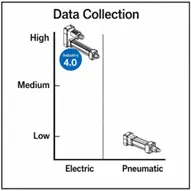
The control of electric motors and actuators has developed rapidly in recent years, making advanced control systems extremely easy to implement. Data collection is simple to deploy because many measuring sensors, such as current and temperature sensors, are already built in, or because critical data follows a predictable pattern. More industrial network communication protocols, such as EtherNet/IP, Profinet, and EtherCAT, are directly available to connect with various PLCs, HMIs, and IPCs.
Although pneumatic actuators are also advancing, it can be difficult to reach a level where data can be used in real time to control a process or predict wear.
Environment, temperature and noise
Since electric actuator systems can contain sensitive components such as motors, encoders, and sensors, pneumatic actuators are typically better suited for harsh environments. However, always check the IP rating and/or specifications to understand which environmental conditions are truly suitable. Today, electric actuators are also available for extreme environments or underwater use, something that is not even self-evident for pneumatic actuators.

Example of an electric actuator for underwater use
Source: https://actintime.be/blog/concens-uw100-onderwater-actuator
Pneumatic actuators can sometimes handle a wider temperature range than electric actuators (approximately -30 to 180°C compared to the typical 0 to 70°C).
However, at high ambient temperatures, air seals can fail, causing the operation to become slow.
High temperatures can also affect the lifespan of grease in motor bearings and cause thermal expansion of metals, increasing friction and wear in an electric actuator.
Pneumatic actuators also generate more noise due to compressed air. Although this has improved over the years, for applications where noise is a critical factor, electric actuators are the better choice.
Maintenance
If you are not a fan of maintenance, electric actuators are the best choice.
The maintenance requirements of a pneumatic actuator are much higher than those of an electric actuator. A constant supply of compressed air must be maintained from a reservoir tank, which is not easy to manage. In addition to the actuator itself, there are many extra components that require maintenance, such as:
· compressor
· valves
· fittings
· damper (muffler)
· lubricator unit
· filter-regulator-lubricator (FRL) unit
· solenoid valve
· air hoses
An electric actuator requires minimal maintenance because there are fewer components that can wear out, thanks to the limited friction of bearings and linear guides. Occasional lubrication may be required in specific applications to achieve the desired service life.
Preventing air leaks is essential in pneumatic actuators. As seals wear, the force delivered by the actuator changes, which further reduces accuracy and repeatability. Pneumatic actuators rely on tight rod and piston seals to prevent air leakage due to wear. Sometimes, it can take a long time to properly adjust or regulate the air flow.
|
|
|


Source: https://www.linearmotiontips.com/electric-actuators-vs-pneumatic-cylinders-total-cost-of-ownership/
Life span
Both pneumatic actuators and electric actuators offer an average L10 service life, based on bearing lifespan.
The service life of an electric motor can be calculated, whereas the service life of a pneumatic actuator can only be estimated. Predicting when air seals will fail is very difficult, so periodic maintenance is essential for pneumatic actuators.
|
TIP: What is L10 service life? |
||
|
The L10 service life is the number of revolutions or hours that 90% of a group of seemingly identical bearings will complete or exceed before fatigue is expected. It is a widely used method to estimate the service life of an electric motor. Because the bearing life is based on the lifespan of the gear grease, and the grease life is reduced by high temperatures, keeping the ambient temperature as low as possible helps to extend the service life. Here is a calculation example from Koyo Bearings.
|


The key to extending the service life of pneumatic actuators is ensuring that the rod and piston seals remain in good condition. Wear on these seals is inevitable. As air leakage increases, efficiency, force, speed, and responsiveness will deteriorate.
The key to extending the service life of electric actuators is keeping the operating temperature low. For both types, always operate within the specified limits.
Ideal applications
The similarities and differences in design between pneumatic and electric actuators lead to differences in their characteristics.
Therefore, the coarse and simple characteristics of pneumatic actuators make them ideal for basic applications with fast end-to-end positioning, while the precision of electric actuators makes them highly suitable for multi-point positioning, advanced motion profiles, and multi-axis synchronization. Even in intermediate applications where speed is not critical and only two positions are required, such as valve opening, the electric actuator is often the more appropriate solution.
Pneumatic actuators can operate in dirtier environments than most standard electric actuators. However, high temperatures can reduce the service life of both types.
If advanced functionality is required—such as closed-loop feedback or data collection—electric actuators offer an integrated, future-proof solution that is much easier to use.
Summary
In the simplest terms, the choice between pneumatic and electric actuators comes down to simplicity, precision, efficiency, and maintenance.
- Pneumatic actuators are smaller, easy to install, and suitable for simple, short-stroke applications with end-to-end movement.
- Electric actuators meet stricter requirements thanks to their superior precision and repeatability, and are ideal for long stroke lengths, multi-point positioning, and advanced motion profiles.
Although the purchase price of pneumatic actuators is lower, it is important to consider the total cost of ownership, including acquisition, energy, and maintenance. Also keep in mind that air compressors consume electricity as well.
In the long term, electric actuators can have lower operating and maintenance costs.
The transition from pneumatic to electric is especially worthwhile for applications that require higher accuracy and repeatability in position, speed, acceleration, and force. They are also better suited for data collection and synchronized multi-axis applications.
With the current focus on efficiency and cost reduction, we expect demand for linear actuators with higher energy efficiency and a more compact design to continue increasing in the coming years.
Credit: This document is based on material written by Johann Tang, Product Specialist at Oriental Motor USA. Special thanks to Johann Tang for providing the original insights and structure that served as the foundation for this white paper.
Geweldige verhalen zijn voor iedereen, zelfs als ze maar voor één persoon zijn geschreven. Als je probeert te schrijven met een breed, algemeen publiek in gedachten, zal je verhaal nep klinken en emotie missen. Niemand zal geïnteresseerd zijn. Schrijf voor één persoon. Als het echt is voor de ene, is het ook echt voor de rest.
Start hier met schrijven...